Introducing Run3D at Achilles Heel
A Deeper Insight Into Your Movement
There's a moment in most runners' lives when something starts hurting and won't stop. You rest it. You stretch. You try new shoes. You get told to strengthen your glutes. The pain eases for a while, then shifts somewhere else. It comes back the moment you increase your mileage. Something's causing it. You just don't know what.
For most runners, the way we've always worked is enough to answer that question. The right questions, a proper fitting, and 25 years of experience matching people to the shoes that suit them. It's how Achilles Heel has looked after runners since 2000, and for the vast majority, it's exactly what's needed.
But some cases call for more. Recurring injuries that shift around. Problems that don't respond to changes in footwear or training. Asymmetries the eye can't catch. That's why we're introducing Run3D, a clinical gait analysis approach that measures exactly how your body is moving.

What Run3D Actually Is
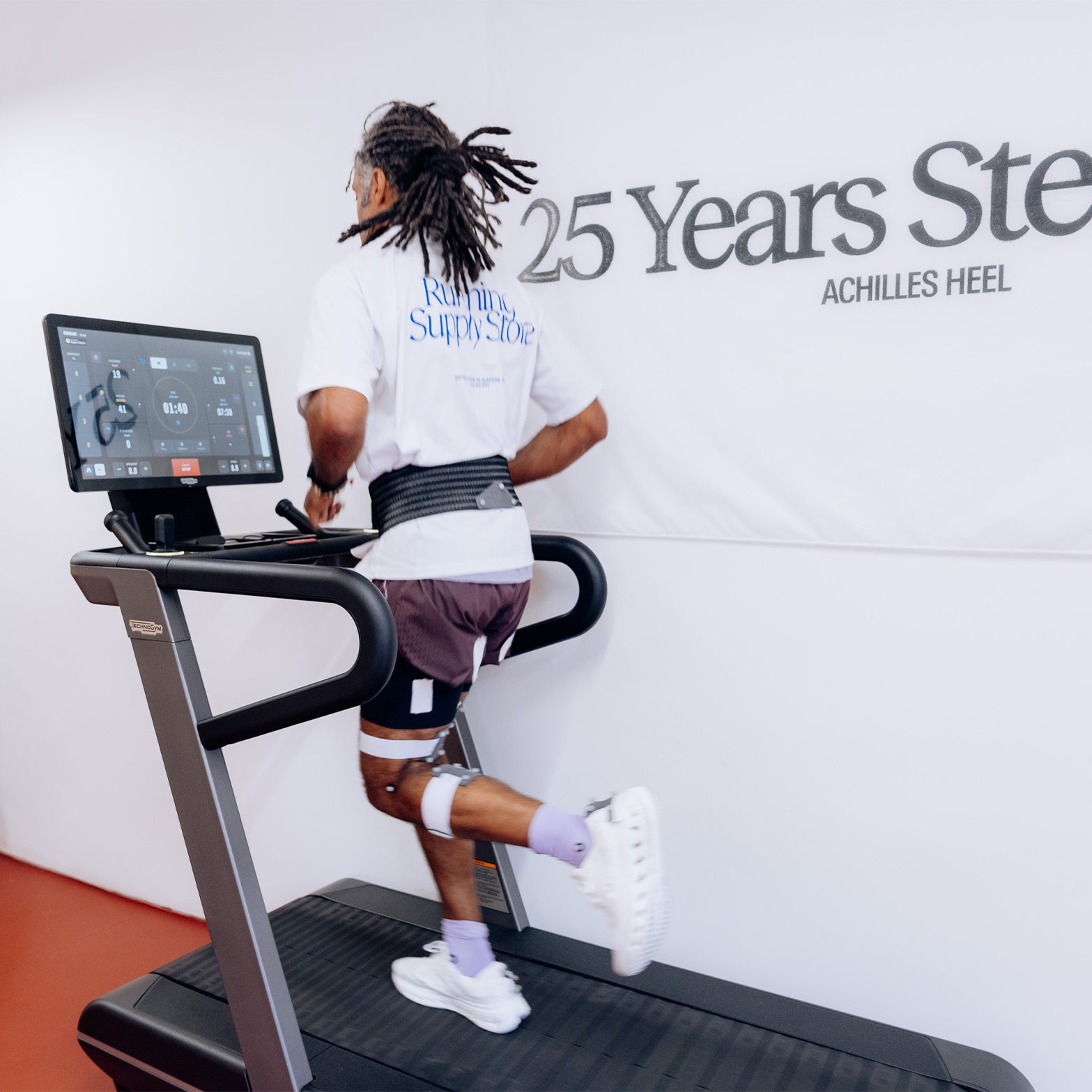
Run3D is a 3D motion capture system developed at Oxford University. Three infrared cameras track reflective markers placed on your lower body, measuring joint angles 200 times per second with sub-millimetre accuracy. The data covers your pelvis, hips, knees, and ankles through the entire gait cycle, capturing more than 30 clinically relevant parameters as you walk or run.
Every result is compared against a database of uninjured runners at the same pace, so you can see exactly where your movement patterns differ from what's typical. Not a rough estimate. Not a subjective opinion. Actual measurement, actual data, and actual answers.
This is a proper step up from standard 2D approaches. True 3D motion capture reveals asymmetries, compensations, and movement patterns that remain invisible to 2D video analysis or visual observation.
Why It Matters for Runners
Most recurring injuries aren't caused by where the pain is. They're caused by something elsewhere in the chain, a weak hip, a rotated pelvis, an asymmetric foot-strike, reduced ankle mobility on one side. The pain shows up wherever the body can't compensate any longer.
Traditional assessment relies on watching, palpating, and educated guesswork. It works up to a point, but the further you go with your training, the smaller the margins become. Run3D removes the guesswork. Rather than estimating what your joints are doing, the system measures them, 200 times a second, throughout the full gait cycle. Rather than assuming there's a compensation, it quantifies it, comparing left versus right and your data against uninjured controls. And rather than hoping gait re-education is working, you see it happening in real-time.
For anyone stuck in a cycle of recurring injury, that clarity is often the missing piece.

What Happens During an Appointment
The full assessment takes about 75 minutes and moves through six stages.
Set-up (10 minutes) - Reflective markers are attached to specific anatomical landmarks on your legs and feet. The cameras pick these up 200 times per second. The set-up looks technical, but it's quick and completely non-invasive.
Gait analysis (15 minutes) - You walk or run on the treadmill while the system records. Multiple conditions can be captured in one session, from different shoes and speeds to running with or without orthotics, before and after cueing. Results display in real-time on a large screen in front of you, so you can see your own movement as it happens. Being able to watch your gait live changes how the whole conversation works. Instead of being told what's happening, you're shown it.
Musculoskeletal testing (20 minutes) - A series of objective clinical tests measures strength, range of motion, structural alignment, and functional control. Hip, knee, and ankle strength across all movement planes. Flexibility of key muscle groups. Single-leg balance. All compared to control data, so weaknesses and asymmetries are quantified rather than estimated. This stage is what separates a proper biomechanical assessment from a pure gait scan. It tells you not just how you're moving, but why you're moving that way.
Report review (15 minutes) - You'll be walked through the full report. Your results are reviewed alongside your history and the reason you booked in. The system compares your findings against control databases and flags the deviations worth paying attention to, so the discussion stays focused on what's clinically relevant.
Treatment planning (10 minutes) - Based on the data, you'll leave with a clear plan. That might include a rehabilitation programme, gait retraining protocols, footwear recommendations, orthotic prescription, or onward referral where needed. Every recommendation is grounded in what the data actually shows, rather than a generic template, so you know exactly why each part of the plan is there and what it's meant to achieve.
Follow-up - Your progress can actually be measured. Repeat the assessment after some treatment and you'll see exactly what's improved, in clear numbers. eeing measurable improvement helps you stay committed to the plan, validates the approach you're taking, and gives you a clear picture of when it's time to progress the training, adjust the plan, or move on to the next stage. Follow-up appointments are booked separately and can be spaced to suit the pace of your recovery or training block.

Who It's For
Run3D isn't just for elite athletes, though it's certainly used by them. The technology has supported the assessment and treatment of thousands of patients, from Olympic-level competitors to older adults seeking to stay active, independent, and mobile.
It's genuinely useful if you're dealing with a recurring injury that hasn't responded to conventional treatment. If you've hit a plateau in training and want to understand why. If you're returning from surgery and want objective evidence of your recovery. If you're preparing for a marathon and want to make sure your biomechanics can handle the load. If you keep buying different shoes hoping one will fix the problem. Or if you simply want to understand how your body actually moves.
The system works equally well for walkers, whether that's someone managing a long-term condition, recovering from injury, or wanting a proper falls risk assessment.
In short, it suits anyone whose day depends on their body doing what it should, and who wants to know exactly what's going on when it doesn't.
What Makes This Different
Gait analysis has always been part of Achilles Heel. Our standard approach draws on targeted questions, careful observation, and the trained eye of staff who've spent years watching how people move. The treadmill's there when it helps, but experienced fitters often don't need it. For most runners walking into the shop, this is more than enough to identify what's going on and match them to the right footwear.
Run3D doesn't replace any of that. It extends it. Where the standard approach works from observation and expertise, Run3D adds precise measurement to the picture: three-dimensional capture, comparison against uninjured controls, and the ability to prove improvement rather than assume it.
Paired with the wider clinic offering, from physiotherapy and podiatry to sports massage, shockwave therapy, and nutrition, it means the pathway from assessment to treatment to objective follow-up all sits under one roof.

Available Now
Sam will be running the Run3D service at Achilles Heel. Bookings are now open, and we'd recommend getting in early if you're interested.
The service is ideal for runners chasing PBs, anyone dealing with recurring injuries, walkers wanting to understand their movement, or anyone simply curious about what proper biomechanical assessment can reveal.
For 25 years, Achilles Heel has been about getting people into the right shoes and back to what they love doing. Adding Run3D means we can now measure exactly why something's not working, what to change, and whether the changes are having the effect they should.
Explore our full clinic services and book in through our calendar.