
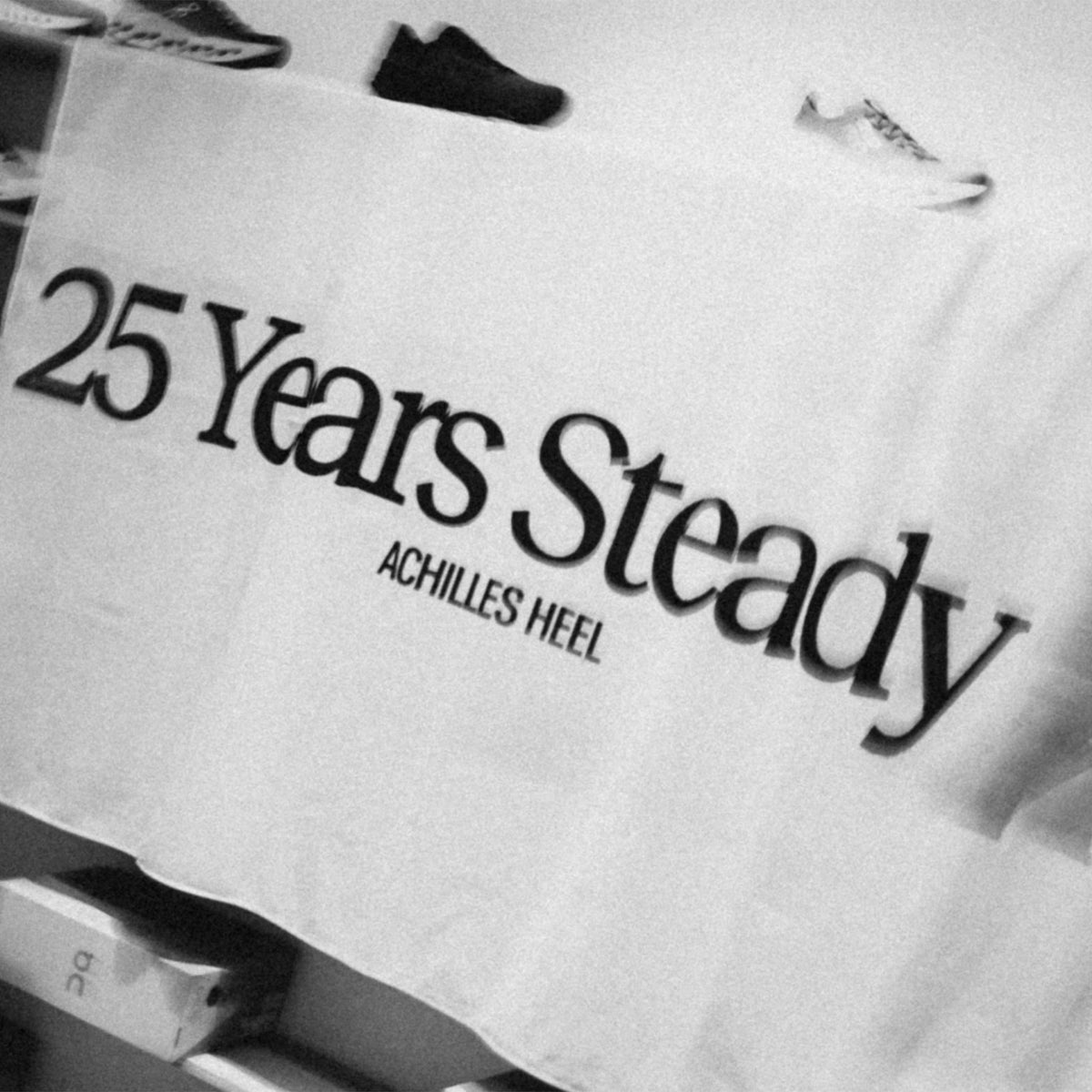
25 Years of Achilles Heel: One Injury, One Vision, Twenty-Five Years
How One Woman Built a Running Community in Glasgow
There's a particular kind of determination that comes from being consistently inconvenienced. For Katie, it was the regular car ride to Edinburgh, an hour's journey just to purchase proper running shoes (yes, just the shoes, not the gear, but more on that later).
The year 2000 marked a turning point. Katie's frustration transformed into action, she built what Glasgow's running community was missing. The shop's name, Achilles Heel, came from a deeply personal place: Katie had ruptured her Achilles tendon during the Edinburgh Marathon. The name serves as a permanent reminder, along with the scar, of pushing through pain to build something lasting.
Twenty-five years later Achilles Heel stands as a testament to determination, resilience, and the power of female vision in the athletic retail industry.

The Only Woman at the Table
In the early 2000s, the running industry operated as a distinctly masculine space. Brand meetings, events, buying decisions—all dominated by men who'd built an industry in their image. Katie found herself repeatedly walking into rooms where she was the only woman, facing questions that revealed just how little the industry understood its female consumers.
"It was very masculine," she reflects. "I think it made me very strong and made me fight more for what we have now."
But here's what's often misunderstood about being the only woman in the room: it's not just about enduring isolation. It's about recognising that you're seeing something everyone else is missing. Katie saw the absence—the missing colours and, most importantly, the non-existent technical features designed for women's bodies.
Katie even jokes about accidentally inventing the 2-in-1 short by layering Lycra shorts under Umbro football shorts for her runs. But the reality back then was less amusing for women, an entire demographic forced to train and compete in products designed for men.
When Katie pushed for variety and colour options, she wasn't just advocating for aesthetic preferences. She was articulating a fundamental truth that the industry had somehow overlooked: women runners deserved products designed with them in mind.

The Milestones That Shaped Success
Every successful business has its pivotal moments. For Achilles Heel, three milestones tell the story.
Making it to Year Three – Business mortality statistics are sobering. The majority of new ventures don't survive their third year. When Achilles Heel crossed that threshold, it wasn't just survival, it was validation. The market Katie believed existed had proven real. Glasgow's runners had been waiting for exactly this.
The Move to Great Western Road – Transitioning from a tiny shop to a prominent high street location seemed massive at the time. "When I look back now, I don't know how I had the guts to do it," she reflects. But sometimes the spaces we think we'll never fill become exactly the right size.
25 Years and Still in Love – The real milestone? Katie still smiles when she walks through the door. After a quarter century, the passion hasn't dimmed. That's not just success in business, but in life as well.
The Power of Community Support
Behind every successful business owner stands a network of believers. For Katie, that started with Kirsty, a close friend who helped shape the early vision, transforming abstract ideas into tangible plans.
But vision alone doesn't open doors. Starting a business requires capital, and securing it proved to be Katie's biggest obstacle. Three banks turned down her loan applications because they "didn't understand the difference between a trainer and a running shoe." So, when traditional finance failed, personal relationships succeeded. Janice provided the initial capital. Harry, who owned the building, offered that crucial first retail space. Sometimes the best investors are simply the people who know you well enough to bet on your judgment.
That same principle extended to building the team. Katie's mum helped staff the original shop while Katie balanced her work as a personal trainer and shop owner. Not long after opening, daughter Sam and friend Christine joined the business, creating the core team that would grow Achilles Heel through those crucial early years.
As the business evolved, so did the team. Son Steven joined, followed by Sam's husband Stef. Today, Achilles Heel operates as a true family business—Sam, Steven, and Stef each contributing their distinct strengths. "We all do our own thing," Katie explains. "It just works."

Witnessing a Revolution
Katie has witnessed a complete transformation of women's running. Back then, women competing was becoming more common, but it still stood out. She's watched the sport evolve from male-dominated clubs and races to a community where women now set the pace as well.
"Now it's more common to see women running," Katie notes. "The amount of women's groups is incredible. There are women doing sports and running that thought they couldn't."
This shift has forced running brands to adapt. Companies now recognise that women drive much of the running market, leading to better product design, more colour options, and technical features that actually serve female runners.

Building Inclusive Spaces
From the beginning, Katie's vision for Achilles Heel prioritised creating a welcoming environment for everyone. The focus lies on a balanced male-female staff so female customers feel seen and represented. This intentionality extends to the product selection, which has always featured extensive women's options, from technical running shoes to stylish running apparel. These deliberate choices fundamentally shape the experience from the moment you walk in.
"Women might like it because they know a female owns it," Katie reflects. "They can come in and feel included."
But the inclusivity extends beyond gender. Elite club runners preparing for championship races shop alongside complete beginners lacing up for their first 5K. Elderly customers seeking comfortable walking shoes receive the same attention as young athletes chasing personal bests. Even people who've never considered themselves "runners", all find space here.
The run club Katie started 25 years ago is literally still running, now led by Stef, it hosts weekly group sessions, regular events and small races, and has become a cornerstone of Glasgow's running scene.
Lessons in Female Leadership
Katie's advice for women entering male-dominated industries carries the weight of lived experience: "Be strong. Stick to your goals and what you want to achieve. Don't let anybody put you off."
The first three to five years will test every assumption, she warns. There will be rejection, three bank refusals, in her case. There will be moments of profound doubt, when the sensible choice appears to be giving up. But understanding that "no" often means "not yet" rather than "never" changes everything.
Katie's second insight addresses something many business owners struggle with: the tendency to work in isolation. Her advice is simple: reach out to other business owners. Create networks. Share knowledge. While protecting competitive advantage might seem smart, that guardedness often limits what's possible for everyone. Twenty-five years have taught her that collaboration doesn't threaten success, it amplifies it.

The Future of Women's Running
Looking ahead, Katie sees continued growth in women's running. "I don't think we're going to see a dip," she predicts. "We're just going to see more and more women being confident to do sport." The pattern she's watching: tentative first runs evolving into 5Ks, then 10Ks, half marathons, eventually full marathons. Each milestone builds confidence for the next.
The parallel to business development is direct. Both require consistent effort, resilience through setbacks, and faith in the process even when progress feels slow.

25 Years and Still Running
After twenty-five years, what sustains Katie is remarkably straightforward: genuine love for the sport, and industry.
"I walk in every day and smile," she says. "It's such a happy place. I'm very lucky to work in an industry that I love." Her gratitude extends to everyone who has been part of the journey – family, friends, staff, customers, brand partners, and the wider running community. "You can't do it alone," she acknowledges. "You need a good, strong team around you."
As Achilles Heel celebrates 25 years, the winning recipe remains unchanged: stay resilient, think forward, and never lose sight of why you started. For women eyeing male-dominated industries, for runners facing their first race, for anyone beginning something that feels impossibly difficult, Katie's journey offers clear evidence.
Read more

Satisfy has finally stepped off the road and into the dirt with their very first trail running sh...
New midsole technology, bold design, and the comfort New Balance is known for—all in one package...